August 27, 2013

Limu - Nori - Seaweed (Poke part 5)

"I don't like seaweed!" is the response my son will give if you ask what he doesn't like about Hawaii. If  you recall, we struggled with fear of the ocean for a while, and in addition to big waves and jellyfish, he was afraid of seaweed wrapping around his legs and holding him underwater.

Limu (LEE-moo) is the generic Hawaiian word for algae and other "plants" that live underwater. Seaweed is a common name for algae, which means it's not a weed or even a plant. Since I'm not a biologist, if you want more information on seaweed, check my favorite source. What does seaweed have to do with poke? It's another flavor option - ‘ahi limu poke!

Now, don't just run in the ocean and grab random limu to mix in with your poke - it might be too spicy! This summer we had a bunch of cases of stinging limu where people had bad allergic reactions after swimming in the ocean infested with a certain type of seaweed. Of course we didn't tell our boy that his fears of seaweed were justified!

If you are looking for limu for your poke, check your Asian specialty market for ogo, which is a specific type of seaweed used commonly in poke. If you really want it fresh from the ocean, first read about edible limu. And then try this tasty looking recipe!

After all my son's dislike of seaweed in the ocean, it was quite funny at Costco when he pointed at a huge package saying "I love that stuff!"

Kirkland Signature Roasted Seasoned Seaweed, 10/0.60 oz

We spent a long time trying to convince him that the dried seaweed he liked to eat also came from the sea. But he had a point that if it's going to wrap around your legs, trap you and then make you itchy for days afterward, I don't care how much I love a food, I don't want to see it in the ocean.

In case you were wondering, nori is the Japanese word for seaweed (red algae), so the dried sheet you see in the picture might be familiar if you like sushi. It is fairly common to see people eating nori out of little bags as a snack, and one of my son's friends apparently got him hooked. Not so much so that we risked buying a Costco-sized package of it though!

Nori is not used in poke, but it is one of the ingredients in furikake, another very common and very delicious seasoning for fish and rice. I just wanted to include it here because it also means seaweed.

This is my final installment on poke, although there is much more to learn! I hope these lessons improved your poke ordering skills and save you the trouble of asking the fish counter guy about each individual word like we did!

Are there other helpful poke variations I missed? Let me know in the comments!

August 26, 2013

Shoyu - Soy Sauce (Poke part 4)

Searching frantically through the pantry, as dinner finished cooking on the stove, I realized with a sinking feeling that I was missing one essential ingredient. Shoyu.

I made stir-fry, and it was the first time cooking Asian food in our new home, so it hadn't dawned on me that I might not have such a common condiment. Like I used to do in Detroit when I forgot eggs, sugar or milk, I asked my neighbor for soy sauce.

Shoyu is Japanese for soy sauce, and apparently there are many variations and types, but I won't go into all of that here. You just need to know that if there isn't soy sauce on the table (which is doubtful in Hawaii), you'll ask for shoyu. I read somewhere it's used so commonly that a local Hawaiian celebrity didn't know that it's called soy sauce on the mainland.

One of the most basic flavors in poke is shoyu. So now you know how to order! Just say "ahi shoyu poke" and you'll be all set! If you're looking for more flavor variety, stay tuned!

August 17, 2013

He’e - Tako - Octopus (Poke part 3)

It was the perfect prank. Tiny takoyaki balls look just like marshmallows - at least when they are covered in chocolate. To try and trick Kyle, I slipped three seafood balls on a stick and dunked them in the chocolate fountain. The hardest part was keeping a straight face while we waited for his reaction as he bit into chocolate-covered tako. It was priceless, even though I am anxiously waiting for payback.

Kids plate - I can't actually remember, but I think the balls on the stick were takoyaki
We were visiting friends in Japan last summer when we saw all kinds of tako, or octopus. Although we didn't try it raw as pictured, we did enjoy takoyaki, minced octopus formed into balls and fried. It was good - but not when you're expecting a marshmallow!

Fresh tako at the Tsukiji Fish Market in Tokyo
Pickled tako?
What does all of this have to do with poke? Well, it seems that tako is most common seafood used (after ’ahi), but look out for other fish and shellfish, depending on the season. Want to catch your own tako? Learn more about wild octopus from this website. Once you've caught one and you'd like to try and make your own tako poke, check out this recipe.

Apparently Whole Foods says no to tako poke
I love tacos, so I was pretty excited to see a sign for "tako poke." I figured the lack of a large Mexican community led to the typo. However, I was a little disappointed to discover that tako was not a spelling error, but is Japanese for octopus. Although we do enjoy poke, I have still yet to try the tako variety, so you'll have to settle for stories about other experiences with octopus.

Maui Tacos, don't mix it up with Tako
Courtesy of: http://www.flickr.com/photos/roenke47/242819202/

Language note: he’e is the Hawaiian word for octopus/squid, so it's interesting that the Japanese tako is used. We have a few other foods that commonly use Japanese words, and I'll get to another one next! With that, I'll leave you with pictures of my chocolate-covered kids.


This is the third installment on poke, if you would like to start at the beginning, click here.


July 31, 2013

‘Ahi - Tuna (Poke Part 2)

If you'd like to try out poke, the most common type you'll encounter is ‘ahi. It's the Hawaiian word for tuna and the word is used almost exclusively - I don't think I've ever seen "tuna" unless it was referring to the canned type.

In case you're a big fish aficionado, ‘ahi can refer to both the yellowfin (kihada) and big eye (mebachi) varieties. Since yellowfin is more common, it's less expensive, and more likely to be used in poke. This helpful seafood website gives Hawaiian names for fish, as well as its sustainability and other interesting facts. Since the Hawaiian and English names for some fish are both used here, I never could keep them straight and this site cleared it up a bit for me.

In case raw fish sounds a little, ahem, fishy to you, keep in mind most cultures have a specialty raw fish recipe. There's ceviche, carpaccio and sashimi, to name a few. The nice thing about poke, compared to sashimi is the sauce. Of course you enjoy the flavor of the ‘ahi, but it is covered in other delicious flavors, like sesame and onion, to help mask the fish if you're worried you won't like it. It's also cut into bite-sized chunks to make it easier to eat. And share! By ordering it with friends, you get to try it without worrying about wasting a whole plate if you don't enjoy it.

But you should order it, because you will probably like it! If you want even less risk, ask to try a piece of ‘ahi (pronounced ah-hee) at a poke counter.

‘Ahi may be the most common seafood in poke, but can you guess what I'll cover next?

(This is part 2 in a series on poke. Click here for part 1.)

July 28, 2013

How to Order Poke (Part 1)

You really can't go anywhere that sells or serves food without seeing poke. It was one of those things that we were really confused by when we first arrived "What is a poke?" "Does it have anything to do with poking?" "I want to try it, but... how do you say it correctly!?"

Since this is such a common food and there's a lot of non-English terms involved, it's pretty important to cover. This is the first in a series of how to order poke.

Definition: Poke means to slice or cut into pieces. So if you slice up some seafood and make a salad = poke. Traditionally it was seasoned with sea salt, seaweed, and crushed kukui nuts. After contact with various cultures, it has evolved and now there are hundreds of varieties to choose from with different meats, vegetables, sauces and seasonings to suit your tastes.

Pronunciation: poe-kay, rhyming with okay. However, you will hear "poe-key," which is not technically correct (because it would be spelled "poki"), but it is an acceptable variation. So either way you say it, you'll get fed.

Location: Fine food markets, grocery stores, convenience stores, farmer's markets, your friend's luau. Basically everywhere.

The grocery store Foodland wins poke popularity contests
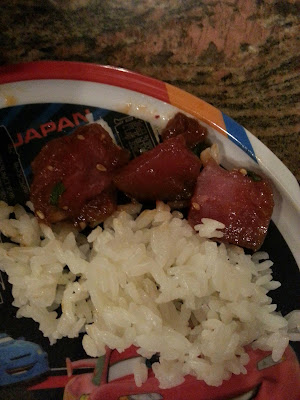
Poke on white rice = poke bowl
You can even buy it at Costco in reasonable amounts!
Although it's common in Hawaii, if you live elsewhere and would like to try poke, here is a recipe! Keep reading for more food terms to help you order some ono poke!