August 20, 2021

Pēpē Nui - Big Baby

(Written in 2016)

I can hardly believe Calvin is 19 months old! It's fun to see his personality develop and watch him learn new things. Here's a little snapshot of what he's up to right now.

Important Stats
Weight: 29 pounds
Height: 34.5 inches
Size 2T (some things 3T!)

Foods
His restrictive diet has been working! The doctor excitedly cleared him to try new foods, so now we're up to six total: carrot, grape, pork, turkey, rice and soy. To mix things up, he enjoys carrots, tofu and turkey fried in bacon grease! Rice allows him rice milk, rice cakes, rice Chex, and even cookies! He has a soy formula to add some nutrients.

Words - You can get a pretty good idea of what he likes by what he can say!
Momma
Poppa (always whispered!)
"Uk" = Lucas
"Bec"= Rebecca
"Ba"= Ball, bottle, or bird
Vroom = Car / pretending to drive
Broom
Moon
Burger = Of the turkey variety
Air = Airplane or helicopter
I = Island

Enjoys
Playing with his siblings
Walking outside
Wearing shoes... on his hands
Hiding in cabinets
Pushing things (carts, strollers, etc.)
Wrestling & tickle fights
Pointing at things in the sky
Pretending - to sweep, drive
Smelling flowers and candles
Peekaboo


Video of walking

Looking back, we didn't get to enjoy this stage as much with Lucas and Rebecca, so I'm thankful for the time now. Why were we a little distracted? Let's see the photographic evidence...
Lucas at 19 mo - welcoming home baby RaeRae

Lucas 3.5, RaeRae 19mo - visiting Great Grandma Steffen en route to Hawaii
Language Notes:
Words: pēpē, nui
Meanings: baby, big
Language: Hawaiian
Usage: Nui is very commonly written. You'll find it used to describe locations, Hawaiian products and silly menu names. Pēpē is not as common, I've only heard it spoken. Keiki is used more generically for children.

November 20, 2015

Kapu - Forbidden


 When planning an international trip with a baby with food allergies, here's my simple plan:
Step 1. Send lots of emails.
Step 2. Make a packing list with a long list of medications.
Step 3. Start stockpiling carrots.
 
Happy camper on the 2am flight to Fiji

Our family had the awesome opportunity to travel to Fiji and meet up with friends from Michigan and Australia! We had two wonderful weeks catching up and having new adventures. There were a lot of logistics in planning the trip - coordinating all our arrivals, two different resorts, two catamaran rides, and a seaplane! Add to the mix researching common Fijian foods, customs requirements and emailing resort staff to make sure our son with allergies would have food - it was quite an undertaking!
  
The staff loved "bacon boy"!

 
 Side note - Background on Calvin's allergies:
4 months old: Constant rash leads us to get blood tests that reveal allergies to milk, eggs and peanuts.
12 mo: New tests show additional allergies to fish, wheat, sesame and soy.
13 mo: Big test of 30+ things show allergies to EVERYTHING!

Now he is on a limited diet of pork, turkey, grapes and carrots. Although it seems restrictive, he loves the foods he can eat. And he really loves not being itchy.

To add in nutrients, he also drinks a supplemental formula that rivals Frappuccinos in price. But not in flavor. At first, he rejected it outright. Instead of serving it cold as suggested, we tried it warm in a bottle and he gobbles it up!

Enjoying his special order grapes-to-go
Back to our trip to Fiji
In order to make his limited diet work for two weeks, there was a lot of research and tons of emails to customs and our resorts. Although we had about 5 pounds of grapes confiscated at the airport, we had no other issues. Both resorts were very accommodating in ordering grapes from the main island so every day he had his very own special order grape and ham plate.

Our friends were really accommodating as well - in fact, I was the one who accidentally ordered the peanut butter and jelly sandwich!

Overall, our journey with his allergies has made us very thankful. He doesn't know what foods he's "missing out" on and is generally pretty happy - even if he's itchy. Food allergies are much more common so people are more understanding. Amazon and specialty stores make it easy to find foods to accommodate his needs.

As of today, he has the green light to start adding back in new foods! Looking forward to adding some variety to his diet.

If you need me, I'll be shopping for carrots.

Language notes:
Word: Kapu
Meaning: Forbidden, sacred or holy
Language: Hawaiian
Usage: Fairly common, especially "keep out" signs

May 20, 2015

Punalu‘u


It's not a secret, but sure feels like one. This tiny stretch of beach has great views of the mountains, soft sand and picture perfect palm trees. Yet, even on a Sunday, was barely inhabited.

Thanks to my awesome husband, I had a fabulous afternoon by myself! I thoroughly enjoyed the sun, waves and peaceful views. It was lovely to eat a snack and read a magazine, just listening to the sound of gentle surf. Perhaps a little better not having to share my snack or help other little people eat theirs. As an added treat, there were paragliders coasting along in the sky!

Since words can't adequately describe it, I'll let the pictures brag for themselves.


We've been here almost four years, and there are still new places to explore! Where shall I go next?

Punalu‘u Notes:
Located off Kamehameha Hwy, halfway between the North Shore and Kaneohe. There's a public beach access just past Keneke's. Continuing further down the highway is Punalu‘u Beach Park.


March 25, 2015

HĀpai - Pregnant

No, I'm not pregnant! But, there are at least five new babies we know of and ten more on the way! So, this post is pretty timely - for them at least. Although I do feel like I was pregnant forever...


I've had the best excuse for not writing. Our nine pound baby boy was born in August! We're so thankful for this huge blessing! He's a wonderful addition to our family, but it definitely puts blogging on the back burner, at least for a while.

One notable difference about being pregnant here is not wearing lei in a circle, so instead it is cut in half and hangs down in front. This comes from fear of the cord wrapping around baby's neck, and some women won't even wear necklaces while hāpai.

Another advantage is not needing to buy different seasons of maternity clothes! And actually utilizing not one, but two maternity swim suits! Did you see pro surfer Bethany Hamilton surfing pregnant? She's amazing! Don't worry, in case you're wondering - my photo was totally staged.


Other than that, you get the same crazy questions and advice people love to share with pregnant ladies. Everyone seems friendlier and more helpful than normal when you're pregnant, and that is magnified in already full-of-aloha-Hawai'i. 


Language Notes
Word: hāpai
Language: Hawaiian
Break down: hā=life, pai=increase
Definition: pregnant
Frequency: very common

November 20, 2014

Puka - Hole

The tiny hole in the Ko‘olau mountains visible from my church parking lot has always intrigued me. So, when a dear friend was checking items off her bucket list before her move to the mainland, I jumped at the chance to do the hike up to the puka. It's a relatively short climb, but very exposed and right along the cliff edge. Not terribly difficult, but enough effort and skill required to really enjoy the view from the top. And a great way to send her off in style!

Bamboo forest at the start of the trail

View towards Kailua and the Pali tunnels


Great views of Honolulu as well!


Mistakenly, we went on the back side and had to climb up this steep face!

This marks the end - you should be standing on top of the puka!

Great view of the Windward side!
Watch out for the wind!
Clear enough to see Chinaman's Hat!

Pali Puka Trail notes: 
Park: Pali lookout parking lot.
Trailhead: Looking at the ocean, go left and follow the rock wall to the trail opening. Head through the bamboo and the trail will start to turn right, heading up the mountain. Follow the edge until you get to the puka. The trail gets much more difficult after that, so be prepared if you want to go further!

Language Notes:
Word: puka
Language: Hawaiian
Translation: hole
Frequency: very common
Ad from the Star-Advertiser

August 27, 2013

Limu - Nori - Seaweed (Poke part 5)

"I don't like seaweed!" is the response my son will give if you ask what he doesn't like about Hawaii. If  you recall, we struggled with fear of the ocean for a while, and in addition to big waves and jellyfish, he was afraid of seaweed wrapping around his legs and holding him underwater.

Limu (LEE-moo) is the generic Hawaiian word for algae and other "plants" that live underwater. Seaweed is a common name for algae, which means it's not a weed or even a plant. Since I'm not a biologist, if you want more information on seaweed, check my favorite source. What does seaweed have to do with poke? It's another flavor option - ‘ahi limu poke!

Now, don't just run in the ocean and grab random limu to mix in with your poke - it might be too spicy! This summer we had a bunch of cases of stinging limu where people had bad allergic reactions after swimming in the ocean infested with a certain type of seaweed. Of course we didn't tell our boy that his fears of seaweed were justified!

If you are looking for limu for your poke, check your Asian specialty market for ogo, which is a specific type of seaweed used commonly in poke. If you really want it fresh from the ocean, first read about edible limu. And then try this tasty looking recipe!

After all my son's dislike of seaweed in the ocean, it was quite funny at Costco when he pointed at a huge package saying "I love that stuff!"

Kirkland Signature Roasted Seasoned Seaweed, 10/0.60 oz

We spent a long time trying to convince him that the dried seaweed he liked to eat also came from the sea. But he had a point that if it's going to wrap around your legs, trap you and then make you itchy for days afterward, I don't care how much I love a food, I don't want to see it in the ocean.

In case you were wondering, nori is the Japanese word for seaweed (red algae), so the dried sheet you see in the picture might be familiar if you like sushi. It is fairly common to see people eating nori out of little bags as a snack, and one of my son's friends apparently got him hooked. Not so much so that we risked buying a Costco-sized package of it though!

Nori is not used in poke, but it is one of the ingredients in furikake, another very common and very delicious seasoning for fish and rice. I just wanted to include it here because it also means seaweed.

This is my final installment on poke, although there is much more to learn! I hope these lessons improved your poke ordering skills and save you the trouble of asking the fish counter guy about each individual word like we did!

Are there other helpful poke variations I missed? Let me know in the comments!

August 26, 2013

Shoyu - Soy Sauce (Poke part 4)

Searching frantically through the pantry, as dinner finished cooking on the stove, I realized with a sinking feeling that I was missing one essential ingredient. Shoyu.

I made stir-fry, and it was the first time cooking Asian food in our new home, so it hadn't dawned on me that I might not have such a common condiment. Like I used to do in Detroit when I forgot eggs, sugar or milk, I asked my neighbor for soy sauce.

Shoyu is Japanese for soy sauce, and apparently there are many variations and types, but I won't go into all of that here. You just need to know that if there isn't soy sauce on the table (which is doubtful in Hawaii), you'll ask for shoyu. I read somewhere it's used so commonly that a local Hawaiian celebrity didn't know that it's called soy sauce on the mainland.

One of the most basic flavors in poke is shoyu. So now you know how to order! Just say "ahi shoyu poke" and you'll be all set! If you're looking for more flavor variety, stay tuned!

August 17, 2013

He’e - Tako - Octopus (Poke part 3)

It was the perfect prank. Tiny takoyaki balls look just like marshmallows - at least when they are covered in chocolate. To try and trick Kyle, I slipped three seafood balls on a stick and dunked them in the chocolate fountain. The hardest part was keeping a straight face while we waited for his reaction as he bit into chocolate-covered tako. It was priceless, even though I am anxiously waiting for payback.

Kids plate - I can't actually remember, but I think the balls on the stick were takoyaki
We were visiting friends in Japan last summer when we saw all kinds of tako, or octopus. Although we didn't try it raw as pictured, we did enjoy takoyaki, minced octopus formed into balls and fried. It was good - but not when you're expecting a marshmallow!

Fresh tako at the Tsukiji Fish Market in Tokyo
Pickled tako?
What does all of this have to do with poke? Well, it seems that tako is most common seafood used (after ’ahi), but look out for other fish and shellfish, depending on the season. Want to catch your own tako? Learn more about wild octopus from this website. Once you've caught one and you'd like to try and make your own tako poke, check out this recipe.

Apparently Whole Foods says no to tako poke
I love tacos, so I was pretty excited to see a sign for "tako poke." I figured the lack of a large Mexican community led to the typo. However, I was a little disappointed to discover that tako was not a spelling error, but is Japanese for octopus. Although we do enjoy poke, I have still yet to try the tako variety, so you'll have to settle for stories about other experiences with octopus.

Maui Tacos, don't mix it up with Tako
Courtesy of: http://www.flickr.com/photos/roenke47/242819202/

Language note: he’e is the Hawaiian word for octopus/squid, so it's interesting that the Japanese tako is used. We have a few other foods that commonly use Japanese words, and I'll get to another one next! With that, I'll leave you with pictures of my chocolate-covered kids.


This is the third installment on poke, if you would like to start at the beginning, click here.


July 31, 2013

‘Ahi - Tuna (Poke Part 2)

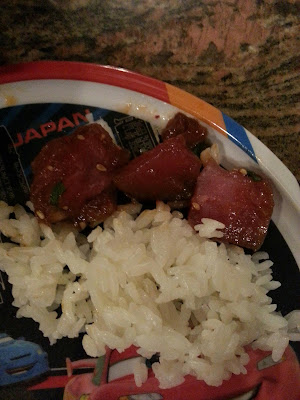
If you'd like to try out poke, the most common type you'll encounter is ‘ahi. It's the Hawaiian word for tuna and the word is used almost exclusively - I don't think I've ever seen "tuna" unless it was referring to the canned type.

In case you're a big fish aficionado, ‘ahi can refer to both the yellowfin (kihada) and big eye (mebachi) varieties. Since yellowfin is more common, it's less expensive, and more likely to be used in poke. This helpful seafood website gives Hawaiian names for fish, as well as its sustainability and other interesting facts. Since the Hawaiian and English names for some fish are both used here, I never could keep them straight and this site cleared it up a bit for me.

In case raw fish sounds a little, ahem, fishy to you, keep in mind most cultures have a specialty raw fish recipe. There's ceviche, carpaccio and sashimi, to name a few. The nice thing about poke, compared to sashimi is the sauce. Of course you enjoy the flavor of the ‘ahi, but it is covered in other delicious flavors, like sesame and onion, to help mask the fish if you're worried you won't like it. It's also cut into bite-sized chunks to make it easier to eat. And share! By ordering it with friends, you get to try it without worrying about wasting a whole plate if you don't enjoy it.

But you should order it, because you will probably like it! If you want even less risk, ask to try a piece of ‘ahi (pronounced ah-hee) at a poke counter.

‘Ahi may be the most common seafood in poke, but can you guess what I'll cover next?

(This is part 2 in a series on poke. Click here for part 1.)

July 28, 2013

How to Order Poke (Part 1)

You really can't go anywhere that sells or serves food without seeing poke. It was one of those things that we were really confused by when we first arrived "What is a poke?" "Does it have anything to do with poking?" "I want to try it, but... how do you say it correctly!?"

Since this is such a common food and there's a lot of non-English terms involved, it's pretty important to cover. This is the first in a series of how to order poke.

Definition: Poke means to slice or cut into pieces. So if you slice up some seafood and make a salad = poke. Traditionally it was seasoned with sea salt, seaweed, and crushed kukui nuts. After contact with various cultures, it has evolved and now there are hundreds of varieties to choose from with different meats, vegetables, sauces and seasonings to suit your tastes.

Pronunciation: poe-kay, rhyming with okay. However, you will hear "poe-key," which is not technically correct (because it would be spelled "poki"), but it is an acceptable variation. So either way you say it, you'll get fed.

Location: Fine food markets, grocery stores, convenience stores, farmer's markets, your friend's luau. Basically everywhere.

The grocery store Foodland wins poke popularity contests
Poke on white rice = poke bowl
You can even buy it at Costco in reasonable amounts!
Although it's common in Hawaii, if you live elsewhere and would like to try poke, here is a recipe! Keep reading for more food terms to help you order some ono poke!

July 23, 2013

One - Sand

Although we live only minutes away from some of the best beaches in the world (according to Dr. Beach), one thing used to keep us from heading out to enjoy those beaches. The one (pronounced oh-nay), or sand. I know it's a ridiculous thing to complain about, but it's hard enough to get sand out of those hard-to-reach places... but then trying to get it off of your kids too? It used to drive me so crazy that I dreaded going to the beach. If this is true for you, read on to see how we're minimizing the one-phobia!

Language tip: One is not really used in day to conversation, so don't try to say "I love the powdery one on that beach!" However, it is very common in place and street names, so it will save a lot of confusion to say it correctly. Say oh-nay, not the number 1.

If you've been reading this blog for a while, you'll know that for the last two years, our kids spent most of their time on the sand. And not just gently scooping it into buckets with shovels. I don't know about your kids, but mine like to dig like crazy, wild dogs. So they end up looking like this:


I'm pretty sure they make cement by mixing sand with sunscreen. Or at least they should because it does not come off!

Even after a thorough shower at the beach, somehow this pile of sand still ended up on the bathroom floor (it looked way more dune-like in real life). I have to remind myself to calm down and just get the vacuum. But, most of the mess is contained when we remember to remove our swim suits in the tub. Many people here have outdoor showers to help with that. We unfortunately do not, and we found that the screams that come from hosing them off in the driveway are not worth it, so they trek upstairs.


In order to avoid the sandy floors and cars, here are some handy tools we keep in our car for beach days. Paper towel, brushes, beach blanket, change of clothes, garbage bag and jugs of water (not pictured). The beach blanket doesn't really keep the kids clean, but is more for the adults and the food. I wish I could give you a simple step-by-step method for sand removal, but it really depends on the type of sand you're dealing with, so you must experiment! Which means trying out different beaches - best homework ever!

Some handy hints: We've found that if you shower at the beach, a jug of water is usually sufficient to get the strays off your feet. However for those beaches without showers, (or if your kids kick and scream through the cold water showers and you'd rather just quickly dash home) you need a brush to help. Fine sand works best after drying out - so brush first, then rinse. More coarse sand does better with a quick rinse then brushing. You'll notice we have two brushes - one is a beauty product and the other is from the automotive aisle. Both work fine, but some people think one is too "scratchy."


Hopefully with these hints you too can finally enjoy the "White Sandy Beach" in Hawaii (or in your neck of the woods) without cringing about cleaning up! What are your favorite beach clean up tools?


July 19, 2013

Mo’o - Gecko

Every morning, the kids fight over who gets to open the "gecko door," the screen door leading down the stairs where the mo’o live. We have a family of at least three. Although there were more before "the accident."

RaeRae had a visitor in her room one night. It was a Madagascar gold dust day gecko. Unlike the other types of lizards and geckos that sneak inside, this one was cute. I tried to catch it or chase it outside, but it just ran around the ceiling, so we let him stay. And he stayed for two days, and during that time he became her "best gecko fwiend" and she couldn't sleep without him watching over her.

Reading to her gecko "fwiends"
One night, I shut the window to keep out the rain. But it didn't shut quite right. I didn't think about it until the next day, when I saw something that used to resemble a gecko in the window frame. Thankfully it was up high enough that Rae couldn't see the mess. I enlisted the help of Kyle to get it out and dispose of it before she could find out. She was disappointed that her gecko "fwiend" wasn't watching her at bedtime, but she thought he'd return the next day after getting some bugs.

Those happy thoughts didn't last long, as I heard crying in the bathroom. Seems the gecko had been disposed of in the toilet, but not flushed. To this day, she'll occasionally ask "Who smashed my best gecko fwiend"?
Distinctive gold spots on his neck and tail
As you can tell by their name, the Madagascar gold dust geckos are not native to Hawaii, which usually is a problem for plant and animal species. For some species, like their larger cousin the giant day gecko, you should call and report a sighting, but not these cute little guys. For a brief history of geckos in Hawaii, you can read more here.
They startle easily, sorry for the shot through the screen door
There are other kinds of lizards and geckos around, but they are mostly nocturnal - and uglier. Although we might be influenced by the talking mo‘o from the Geico ads, we love seeing these guys. Not only are they brightly colored, but they also eat nasty bugs!

And we'll be a little more careful with doors and windows so hopefully we won't have any more tragic accidents in the future!

July 12, 2013

Mokoli’i - Chinaman's Hat

Here's the secret: I'm not adventurous. Also, I'm a pretty bad swimmer. And my level of anxiety in the ocean is probably clinical. So swimming to an island 1/3 mile offshore, with our kids in a raft seemed like a really terrible idea.

Despite all that, we spent an afternoon swimming out to Mokoliʻi, locally known as the very politically correct Chinaman's Hat. Because it looks like a hat. It really could be any kind of hat, but since the Chinese were a large immigrant group here, it stuck. Based on its shape, to me it looks more like "Sorting Hat Island." 
It looks so far away!
Anyway, Kyle had done it twice before, once with our son in the boat. So I had to trust Kyle. And take lots of calming breaths.
Shaka time!
Wisely, Kyle brought along a jump rope to tie to himself so he could tow the boat. It also served as a communication device in case of emergency.We had a safety briefing so if anyone fell out of the boat, someone would pull three times on the rope. Glad that wasn't an issue!


Halfway there!
Photo courtesy of the children
Spotted a honu!
Using slippers to help swim better
Made it!
View of Oahu from Chinaman's Hat

The swimming leg of a sprint triathlon is shorter than that! So if I can do a triathlon with a snorkel and goggles, and stop halfway through for a snack break, then I'm all set!
 
This guy can climb!
And so can this girl!
Secret beach!
You can see the island of Moloka‘i on the horizon - just look in the big gap between the two little islands


The clouds looked ominous, but just stayed over the mountains
More climbing
This cave was sandy last time they visited


Looking at tide pools
Found a little hermit crab
And an even littler one!
Feather duster worm: before...


...during...


...and after.


Enjoying their free ride with a free sucker

Although I'm not really a risk-taker, I'm thankful for my adventurous husband who forces me out of my comfort zone so I can experience cool things like this!

You can do it too! To access Chinaman's Hat, you'll want to park at Kualoa Beach Park (not the ranch). Any place will do, but there is a rock wall protecting the beach in some areas, so unless you want to hop over it, launch from a different spot on the beach.

Although I'm not a strong swimmer, I can swim and have done so in open water before, so please do use caution. It is possible to walk most of the way to the island at low tide, since the water is about 4 feet deep. But, there have been drownings - be aware of the time for high tide and ask the lifeguards about the currents if you are unsure.

And if you want to try it, you can always borrow our raft!